Security
Tap-verified, post-quantum end-to-end encryption.
Trust starts in the real world. The cryptography enforces it — not policy. You can chat with people you've physically tapped with, or with someone connected through exactly one tapped friend. The network does not keep expanding forever. Messages stay end-to-end encrypted across servers, offline delivery, and Bluetooth mesh relays. Relays can help move packets, but they do not get the keys.
Tap-bound trust
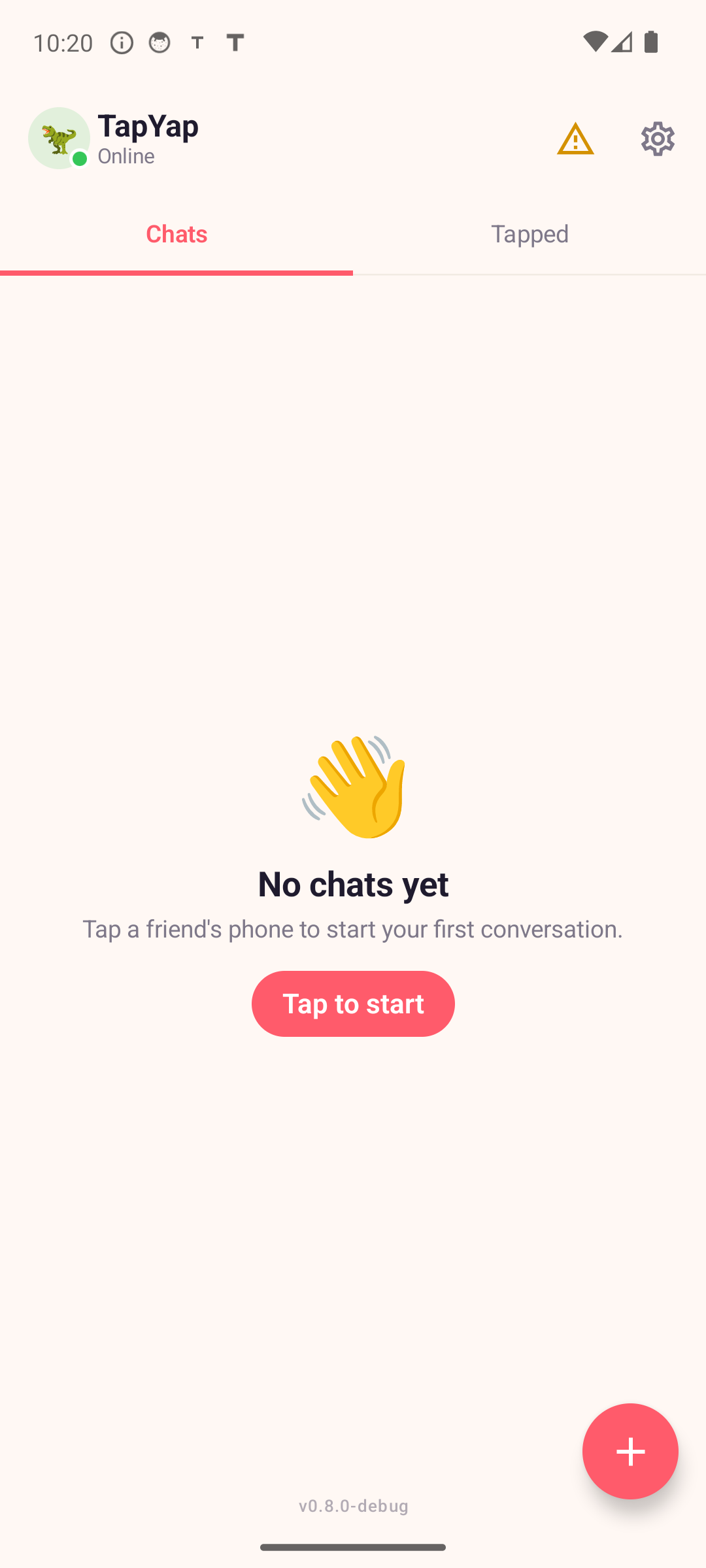
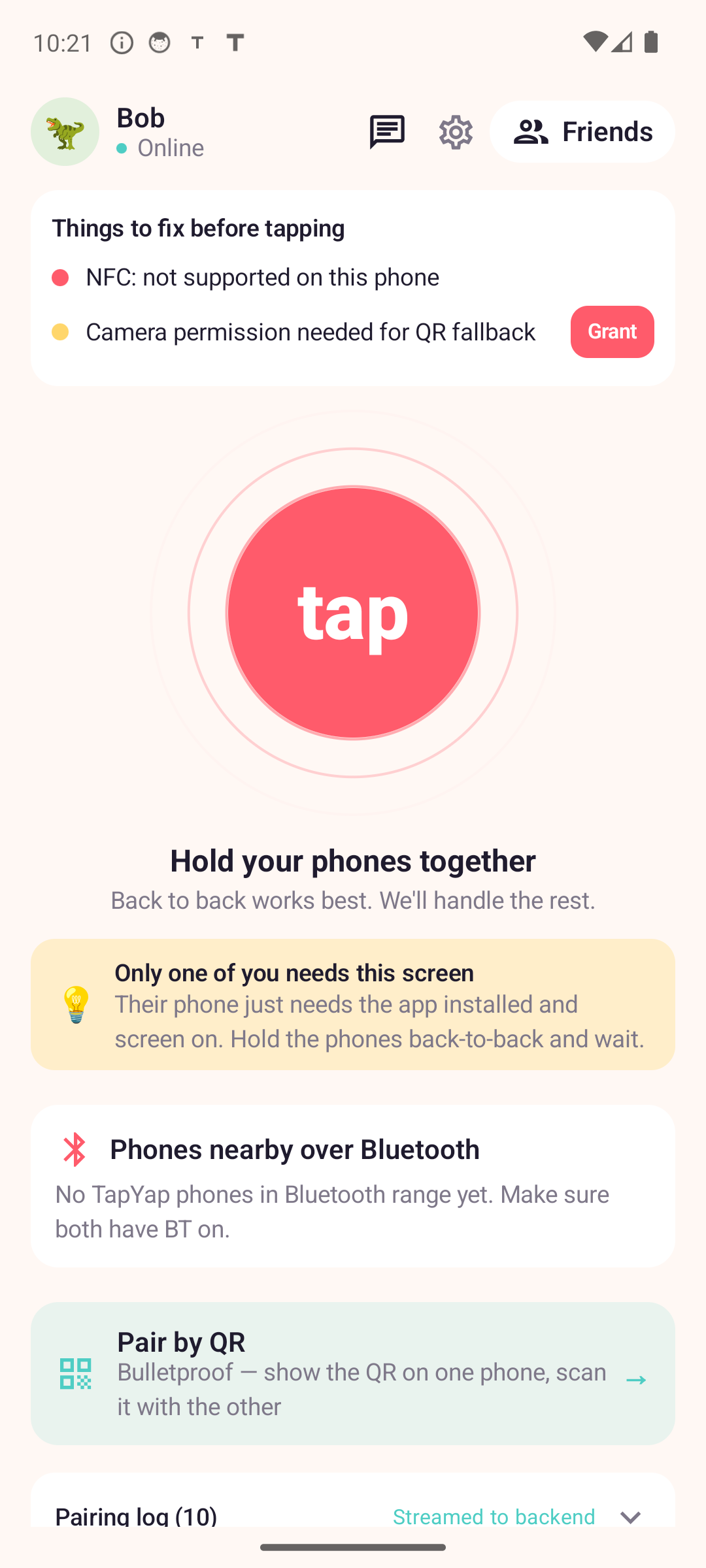
Every chat relationship is rooted in a physical tap. We don't take strangers' word for who they are; the tap creates a four-signature certificate that cryptographically records the in-person handshake. Your social graph can't grow past two hops — ever — because no one, not even the server, can mint a third.
Hybrid post-quantum, by default
Provides forward secrecy and post-compromise recovery against both classical and post-quantum adversaries. We default to NIST's Category-5 parameter sets — ML-KEM-1024 for key agreement and ML-DSA-87 for identity signatures — not Category 3, which is what most messengers ship. A session breaks only if both classical (X25519) and lattice (ML-KEM) cryptography fall — not one or the other.
Server is blind
The server stores opaque ciphertexts and signed public keys. It cannot decrypt your messages, mint a tap certificate, or extend a friend-of-friend relationship into broader graph access. The cryptography enforces it, not policy — even a fully compromised server cannot read what you send.
How TapYap compares to Signal
Signal's protocol is the cryptographic gold standard for messaging, and TapYap is built on the same family of primitives. We match Signal on the cryptographic core. Where TapYap goes further is in what it adds on top: physical-tap binding and a hard 2-hop graph ceiling that no other mainstream messenger has shipped.
| Property | TapYap | Signal |
|---|
Hybrid post-quantum key agreement
(X25519 + ML-KEM lattice) | Yes — ML-KEM-1024 | Yes — ML-KEM-768 |
Hybrid post-quantum identity signatures
(default; Category 5 vs Category 3) | Yes — Ed25519 + ML-DSA-87 | Partial — Ed25519 only |
Forward secrecy & post-compromise recovery
(Double Ratchet) | Yes | Yes |
| End-to-end encrypted media (photos, voice notes, files) | Yes | Yes |
| Cryptographic physical-tap binding for first contact | Yes | No |
| Cryptographic 2-hop social graph ceiling | Yes | No (open graph) |
| Bluetooth mesh transport (works offline) | Yes | No |
| Sealed sender (server can't see who messages whom) | Roadmap | Yes |
| Key transparency / verifiable directory | Roadmap | Rolling out |
| MLS for groups | Roadmap | Rolling out |
| External cryptographic audit completed | Pending | Yes |
| License | Closed-source
(commercial-friendly deps) | AGPL-3.0 |
Honesty matters here: Signal has a multi-year head start on operational maturity — their code has been stress-tested by hundreds of millions of users and audited multiple times. We're newer and have an audit pending. The architecture is comparable; the production hardening of the implementation will catch up over time.
Privacy modes (opt-in)
Beyond the strong default cryptography, two opt-in modes are available for users with elevated threat models — corporate legal, journalists, activists, dissidents, anyone whose adversary is willing to spend real resources:
- Tap-only mode. Disables friend-of-friend chats entirely. Your graph collapses to "people I have personally tapped," nothing else. New 2-hop session attempts are refused at the cryptographic layer.
- Auto-wipe on PIN failure. After five consecutive failed PIN attempts, all TapYap data on the device is cryptographically zeroized. You'll need to re-pair with every contact via fresh taps. Useful when device theft is a real concern.
We do not have a "maximum security profile" toggle for the cryptographic primitives because we already run the higher-strength NIST parameters by default. Per-message and per-video-frame work uses symmetric encryption (XChaCha20-Poly1305) which is unaffected by post-quantum parameter choice; the only cost of running Category 5 over Category 3 is ~25 ms once per new chat and ~3 KB of one-time bandwidth, both of which are imperceptible. So we just turned it on for everyone.
Live in v0.9.0: paired devices exchange messages end-to-end encrypted via TYSPv1 today — X3DH+PQ session establishment, hybrid Ed25519 / ML-DSA-87 signatures over every prekey, and Double-Ratchet message keys rolling forward on each reply.
Technical detail (TYSPv1): TapYap Secure Protocol v1 uses hybrid X25519 + ML-KEM-1024 key agreement, a Signal-style Double Ratchet with periodic post-quantum re-keying on the roadmap, ChaCha20-Poly1305 authenticated encryption, and hybrid Ed25519 / ML-DSA-87 device identity signatures. Physical taps create four-signature Tap Edge Certificates; friend-of-friend chats use short-lived, non-transitive Introduction Capabilities. Bluetooth mesh packets are opaque encrypted envelopes with rotating route IDs, replay protection, and strict two-hop social limits. Real-time audio/video calls (post-launch) derive SRTP keys from the underlying ratchet so TURN/STUN servers see only encrypted streams.
TYSPv1 is currently in pre-audit review. Once external cryptographic audit is complete, we will publish the audit summary, the full whitepaper, protocol diagrams, and test vectors here. Until then, language on this page describes design intent (“designed to provide”, “post-quantum-hardened”) rather than proven properties. We will also reassess the cryptographic stack against major NIST / IETF updates and emerging post-quantum advancements (including future hybrid-protocol research) as they mature; the wire format includes algorithm-version negotiation so upgrades roll out without breaking existing chats. The full protocol specification and threat model are available in the public repository.